
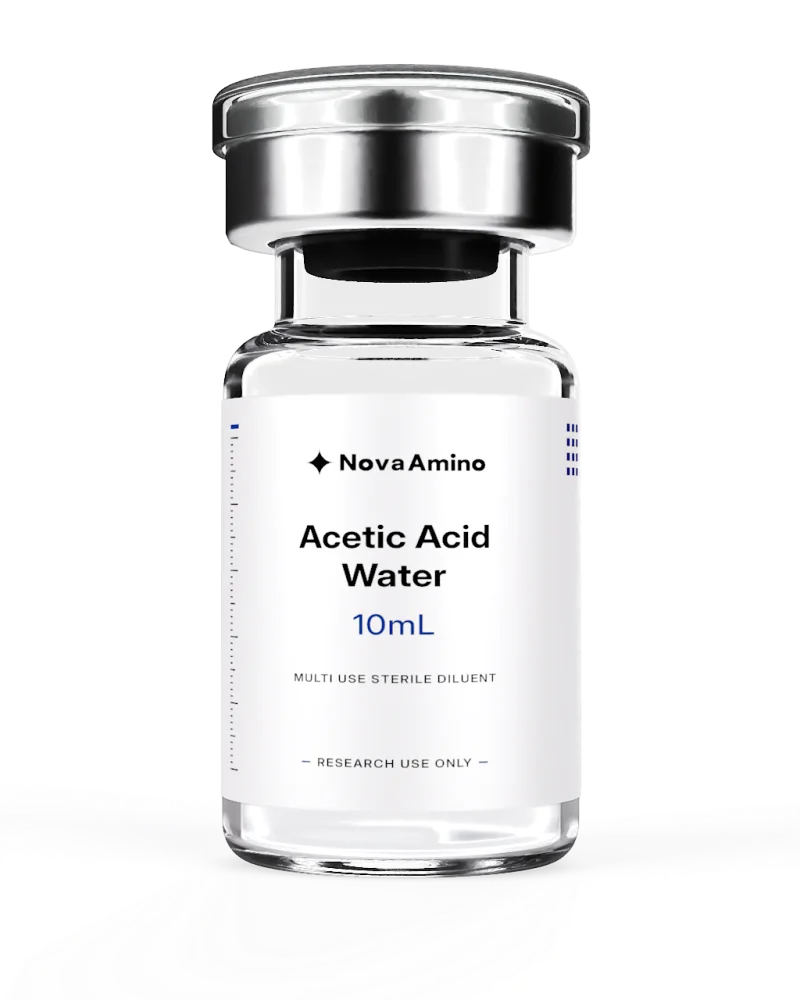
Acetic Acid 0.6%
Loading...
Technical Specifications
Research-Grade Acidified Solvent
pH 3.0Acidic EnvironmentMaintains protonation of charged amino acid groups — prevents peptide aggregation at isoelectric point
1 yearIGF-1 LR3 StabilityIGF-1 LR3 remains stable for up to 1 year at 2–8°C in acetic acid vs. only 7 days in BAC water
3Peptides Requiring ThisIGF-1 LR3 (required), AOD-9604 (recommended), MOTS-c (batch-dependent)
NoBacteriostatic ActionUnlike BAC water, contains no preservative — strict aseptic technique required at all times
Specifications
Grade
Pharmaceutical Research Grade
Active Component
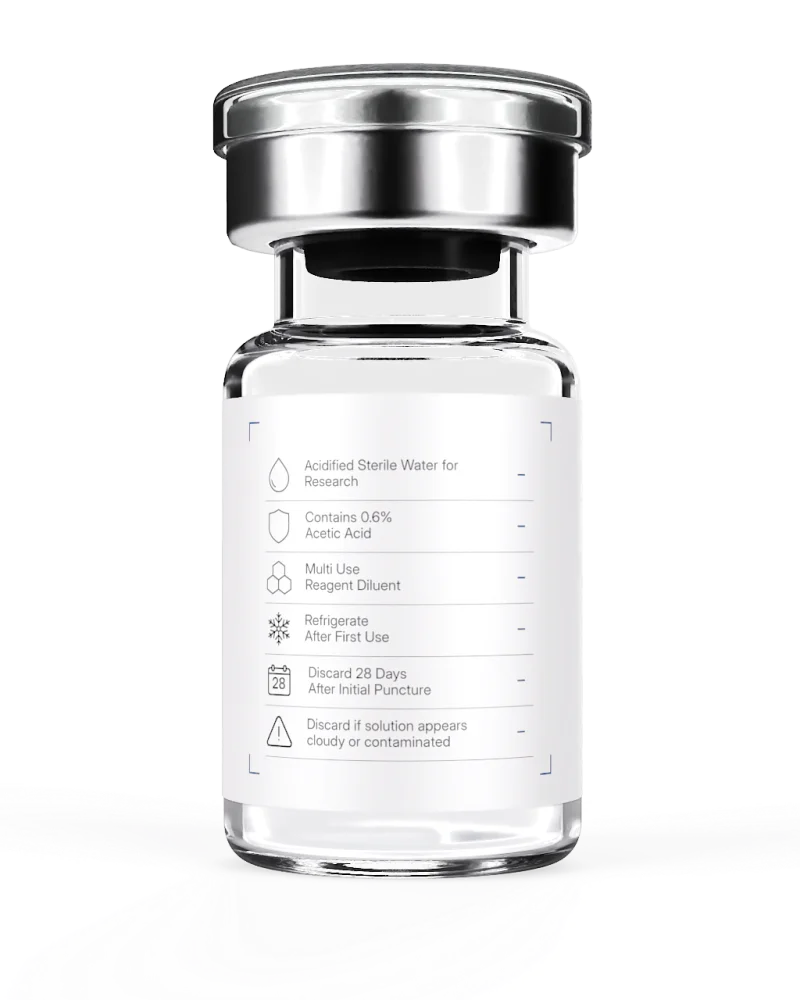
0.6% Acetic Acid (CH₃COOH)
pH
3.0–3.5
Sterility
Sterile, non-pyrogenic
Preservative
None — no benzyl alcohol
Manufacturing
GMP-compliant facilities
Multi-Dose Window
28 days after first puncture
Shelf Life (Unopened)
2+ years at 20–25°C
Peptide Compatibility
Which compounds use this solvent
Acetic Acid 0.6% is a specialized solvent for peptides that aggregate or gel in BAC water. Most peptides do NOT need this — use BAC water as default.
IGF-1 LR3Acetic AcidRequired — gels at neutral pH (isoelectric point near 5.7)
AOD-9604Acetic AcidRecommended — may aggregate in BAC water
MOTS-cEitherBatch-dependent — test BAC water first
All other peptidesBAC WaterUse BAC water — acidic pH unnecessary
Solvent Science & Research Protocol
Solvent science, reconstitution protocol, and storage
Solvent Science
Peptides like IGF-1 LR3 have isoelectric points near neutral pH (~5.7), where net molecular charge is zero. At zero charge, intermolecular hydrophobic interactions dominate, causing peptides to self-associate into insoluble aggregates (visible as cloudy gel). Acetic acid 0.6% shifts pH to 3.0–3.5, protonating amino acid side chains and restoring net positive charge. This electrostatic repulsion keeps peptide molecules separated in solution, maintaining clarity and bioavailability. The 0.6% concentration is optimized: acidic enough to prevent aggregation, mild enough to avoid peptide denaturation.
Research Protocol
- Sanitize rubber stoppers of both vials with 70% isopropyl alcohol swabs. Air dry 10 seconds.
- Calculate reconstitution volume (typical: 1 mL for IGF-1 LR3 1 mg vials).
- Draw calculated volume of acetic acid using a sterile insulin syringe (25–29G).
- Inject slowly against the inside wall of the peptide vial — never directly onto powder.
- Allow 1–2 minutes for dissolution — peptides dissolve faster in acetic acid than BAC water.
- Verify solution is clear and colorless. If cloudy, allow additional time or gently roll.
- For injection protocols: further dilute with BAC water after initial dissolution to reduce acidity at injection site.
- Label vial with reconstitution date and volume. Refrigerate at 2–8°C immediately.
Storage Requirements
Unopened20–25°C (68–77°F), protect from light
After First PunctureRefrigerate at 2–8°C — discard after 28 days
Reconstituted IGF-1 LR3Up to 1 year at 2–8°C (vs. 7 days in BAC water)
Important
—Do NOT freeze — destabilizes solution and compromises pH buffer
—No bacteriostatic preservative — strict aseptic technique required
—Characteristic vinegar-like odor is normal — work in ventilated area
—Discard if solution appears cloudy or contains particles
—For research use only — not approved for any medical use